Understand Real Conversations in English: Test your comprehension
A Real American Conversation (Step by step!)
Having real, authentic conversations. With your friends. With your favorite coworkers. With a client, to build a connection.
That’s a main goal of learning English… But it’s also one of the hardest things for you to do!
How can you understand American people, when they talk so fast? When they “forget” to pronounce clearly half of their words? When they use real-life expressions that you don’t know?
It’s also a skill you can use with Podcasts in English or TV Series in English… But conversation is the #1 goal.
Let me help you with that.
I’m your English coach Christina, and in today’s episode, I’m going to introduce you to my friend Michael. He makes an appearance in my program Understand Real American English. He’s a former Marine who now lives in Texas, and we’ve been friends forever, like since we were born!
Index:
1) Understand a real American conversation: “Meet Michael”
Here is one minute of my conversation with Michael.
What can you understand?
(The full conversation–and many other conversations–are available with explanations, transcripts and exercises in my course Understand Real American English)
2) Understand a real American conversation (Part 1): Accents and vocabulary
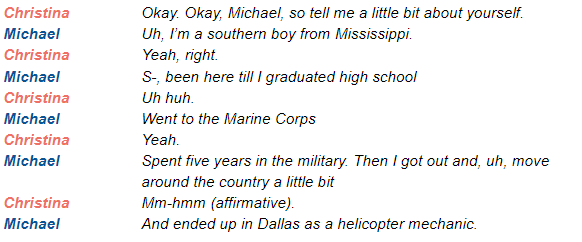
Now, let’s try explaining what’s going on, with a full transcript and comments.
Are you ready for the first part? Here it com
Notes:
Like me, Michael is from Mississippi, but now lives in Dallas, Texas. And you can hear it in his accent!
For example, the words aren’t as clearly separated maybe as my accent. But that’s how it works in real life!
English speakers will put more emphasis on the stressed syllables, and will not speak the rest of the word as clearly. For instance: HElicopter MeCHAnic.
If you don’t understand a word because of the stressed syllables, don’t panic. There are lots of ways you can clarify things when you don’t understand something in English.
Finally, you might have noticed that American military uses the French pronunciation for Marine Corps. The final “p” and “s” are silent, or it will sound like “Corpse” (a synonym for a dead body!)
Notes:
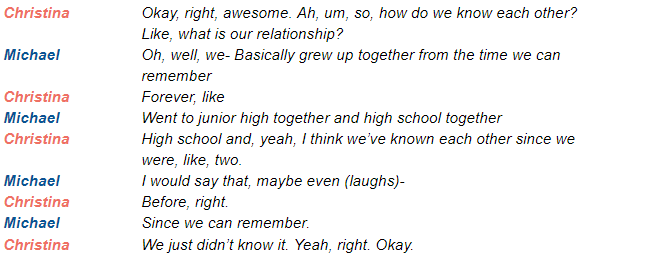
So here I interject, and we speak some words over each other. That’s what happens sometimes in real conversation, too. Especially for Americans!
Junior high or junior high school is another name for middle school, the school for teenagers aged between thirteen and fifteen, more or less.
Learn more about the American School system here!
3) Understand a real American conversation (Part 2): Filler words and advice
Notes:
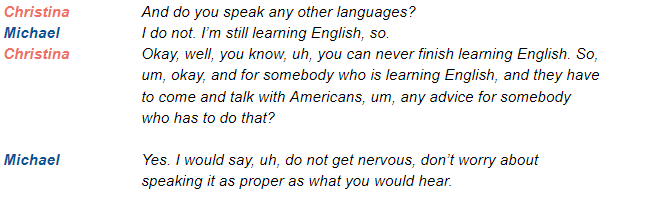
We’re both using filler words while we’re looking for the words to finish my sentence: “Okay… Well… uh…”
Sometimes a sentence isn’t grammatically correct in the end, but it’s OK! Like, “Any advice for… ?” doesn’t have a verb here.
It could be “Do you have any advice for… ?” for example.
But the shorter sentence, without a verb, is fairly common anyway, so Michael understands the question. And if you also know some idiomatic expressions in English, this can help you understand quickly without having to think about grammar and vocabulary!
Notes:
“If you don’t say it the correct way, you’ll eventually get it right.”
He’s right! Practice, and studying real conversations, will help you improve your English in the long run!
And that’s exactly the kind of thing you can find in Understand Real American English.
Your turn now:
How much did you understand the first time?
How much did you understand, with the subtitles?
Tell me, share it with the world in the comments below!
When I first arrived in France, I felt like I didn’t understand a lot of conversations around me. And I couldn’t participate! I made a whole video where you can find my whole story: My Immersion Story
And the lessons that I learned in my experience with French will help you learn English better and faster! See you in that episode!
More good stuff...
Click the image to learn more
15 Comments

Rihabe Sidayne says:
Hello Christina!
Thank you very much!
I understand almost everything but it takes effort.
What makes things difficult for me is that the words aren’t as clearly separated in a real english conversation.
I love the explanations and it’s easier to understand this conversation with subtitles , the vocabulary isn’t difficult,
Have a great day!
Rihabe

georgessiffredi says:
Good idea I have had the same one year ago. I learned by heart the three first verses of the CHAOS. I enjoy to start the day repeating
them under the shower.
” tear in eye, your dress will tear”
” just compare heart, beard and heard”
“dies ans diet………and so on.
When I repeat that, that sounds English and I’m glad for all the day even if it rains!

Natallia says:
Hi, Chistina.
Certainly we understand better with subtitles as we were tuaght to understand written texts at school. And when we read and meet new words we can look them up but when we listen without subtitles we cannot catch unknown words. As for me I listen without subtitles for the first time, then with subtitles, then again without.
Your short video are convinient for listening several times. Thank you so much for sharing.

Christina Rebuffet says:
I agree, Natallia, and this is one of the reasons why many people have difficulties understanding real conversations later in life. In school, many people focused mainly on written English, or on dialogues that were scripted and clearly articulated (which are useful for certain reasons, but you need both types of audio resources to improve, really). And you have the right approach: Listening without subtitles to test yourself, and then with subtitles to check your understanding and clarify! Keep it up!

Siffredi says:
Hi Christina
Very interesting podcast
Right now I understand 90% of your comments
30% during the conversation
Unfortunately I read the subtitles without listening exactly the conversation
Christina Rebuffet says:
Next time, you’ll have to try listening without the subtitles! But there will be more videos like this coming soon, so you’ll be able to test yourself again!

Franger Jose Sifontes says:
Hi Christina
In terms of one minute conversation l understanded a 30% without explanations. The most difficult part to me was the use of idioms, l think
Thanks !
Christina Rebuffet says:
Hi Franger,
Sounds like you have room for improvement, but 30% is a good start! Often, it’s a combination of vocabulary, idioms, and pronunciation that can make it difficult to understand real conversations. What difference did you notice between how much you understood without subtitles or explanations vs. with subtitles?

Gholamreza says:
Hi Cristina,I saw the video and without understood almost 80% the first time.
Thank you very much.
Gholamreza says:
Hi Cristina,I saw the video and without subtitle or commentary I understood almost 80% the first time and I receive the general message.
Thank you very much.
Christina Rebuffet says:
Hi Gholamreza, That’s great, sounds like you have a pretty good ear! Keep up the good work!

Anne marie says:
Hello Christina
Ils the first time i try to write
On the video i understand the global meaning
But i understand better When you speek
Its more difficult to understand Mickaël
Thank you Christina

Serg says:
Christina, thank you so much for your detail working for us. It was very understandable. Some words of Michael was hard to hear. But you transcript helped me. I wish you all the best.

tushal says:
hey Cristina I understand 60 percent of the
conversation but I don’t understand some native speakers without subtitles thanks for asking this be happy take care of your self .

Raul says:
I understood almost all, except when you make the last question to Michael because it is a short question When someone without enough practice like me can´t catch a short question is because one need to practice.
Leave a Reply

Business English lessons & tips

Improve faster and feel more confident with my free English lessons. Sign up today.
MOST RECENT EPISODES