The singular pronoun “they” in English

They is a singular pronoun
Hey, and welcome back to Speak English with Christina!
Today, I have big news for you, something surprising. You ready?
In English… “they” is a singular pronoun.
Yep. You can use “they” as both a plural and a singular pronoun. Whaaaat?
I know, it’s surprising! Maybe even shocking.
But if anyone has questions, they can ask in the comments.
Did you see what I did there?
There’s a pronoun in that sentence: “They”.
We’re going to talk about grammar today, so let’s start with a quick reminder.
WHAT’S A PRONOUN?
A pronoun is a word we use to avoid repeating the same noun several times.
It sounds heavy to say “I saw Jay yesterday, but Jay didn’t say anything about having dinner with Jay and Vicki.”
So we use pronouns: I saw Jay yesterday, but HE didn’t say anything about having dinner with HIM and Vicki.”
We have subject pronouns: I, you, he, she, it, we, they.
And object pronouns: me, you, him, her, it, us, them.
You probably know that “they” and “them” are plural, but they’re also…singular.
THE SINGULAR PRONOUN THEY & THEM
Look at these examples. They use the singular “they”, the subject pronoun.
- “Nobody wants to make mistakes in English. If THEY study & practice regularly, they’ll make fewer mistakes!”
- “Everyone wants to speak fluent English, but THEY don’t have to be perfect to be fluent.”
OK, maybe not everyone, but a lot of people.
These examples use the singular them, the object pronoun:
- “If someone made a mistake, you should tell THEM politely.”
- “Do you have a friend who wants to learn English? Then please share this lesson with THEM!”
Why do we use “they” and “them” in these examples? Because it’s English, and English has weird rules.
No, that’s not the real reason. We use “they” and “them” as singular pronouns because it’s the gender-neutral singular pronoun.
He & him is obviously masculine. She & her is feminine. And they & them is gender-neutral.
Here’s a good example of why this neutral singular pronoun is useful. We could say “If anyone has a question, he or she should ask his or her teacher.” Ugh, that’s long and complicated.
But if we use the singular they & them:
“If anyone has a question, THEY should ask THEIR teacher to can help THEM understand.”
Short, simple. Like English grammar magic!
Maybe this is a totally new aspect of English grammar, so here’s a recap:
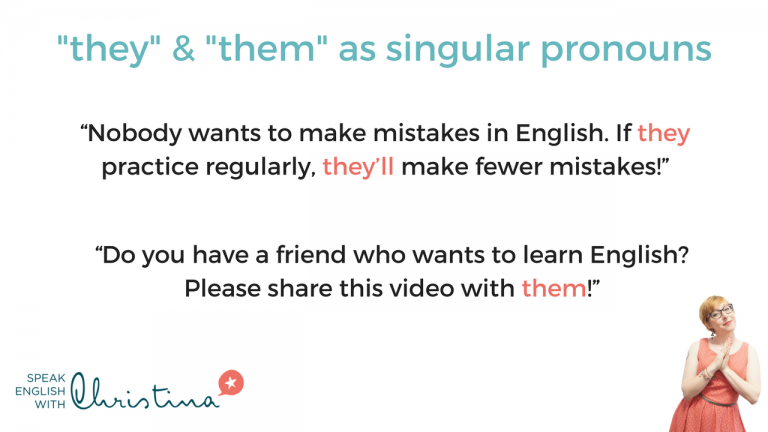
WHEN TO USE THE SINGULAR PRONOUN THEY & THEM
Now how do you know when you can use the singular they & them?
There are some key words that tell you. For example:
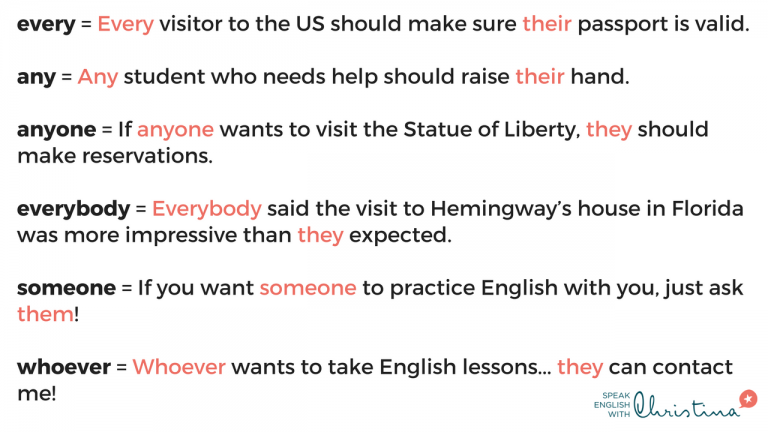
Watch the video lesson, and I’ll explain all of this to you:
WHAT ABOUT YOU?
Did you know of this grammar rule before you watched this video? Do you want to try it?
Write some examples in the comments below so you can practice.
We’re all friends here, so don’t worry if you make mistakes. That’s how you learn.
And if anybody has any questions, they can ask in the comments 😉
Have fun,
Christina
P.S.
Thanks so much for being part of the Speak English Community.

<script async data-uid=”20e6eeeac5″ src=”https://f.convertkit.com/20e6eeeac5/c4f64ebad3.js”></script>
More English lessons...
Click the image to see the lesson



Leave a Reply

Business English lessons & tips

Improve faster and feel more confident with my free English lessons. Sign up today.
MOST RECENT EPISODES