Confusing words in English: Client or customer, what’s the difference?
Confusing words in English: Client or customer, what’s the difference?
Index:
“Client” or “customer”? Which is the correct word for your business?
First, let me reassure you! Even native speakers are not always 100% sure of the difference.
So, let’s clarify this difference, so you never confuse them again!
1. Client or customer?: What they buy
The short explanation is this:
Client: buys services
Customer: buys products
But it can be more nuanced than that. (Remember, English is rarely super simple! But that’s what makes it a good challenge, and fun to learn, right? 😉
Look at this explanation, with examples:
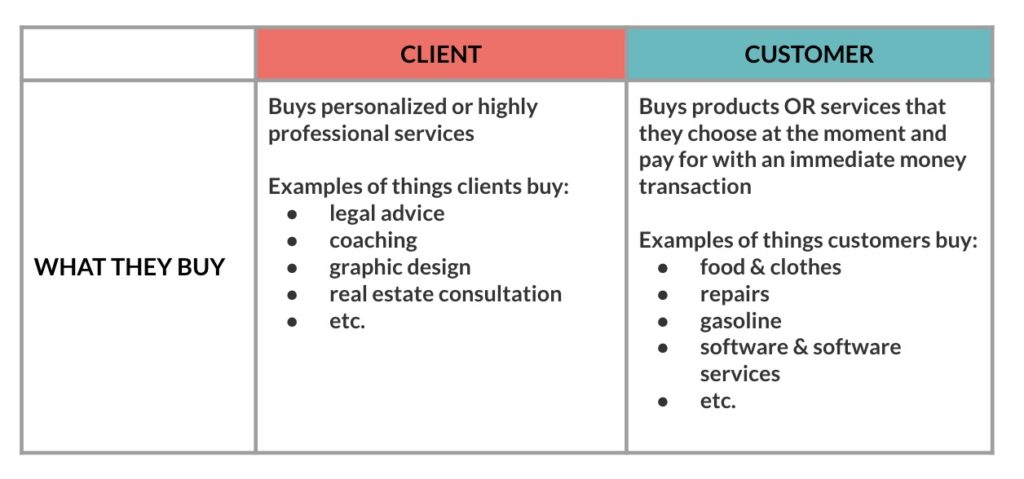
That gives you some concrete examples to remember!
Also check out my lesson: How to Pitch Your Business in Conversations
2. Client or customer?: Consider the relationship
The short explanation is this:
Client: there is more accompaniment & support from the seller
Customer: it’s an immediate exchange of money for products/services without much accompaniment or support
Again, let’s add some nuance to this:
Insert this image here:
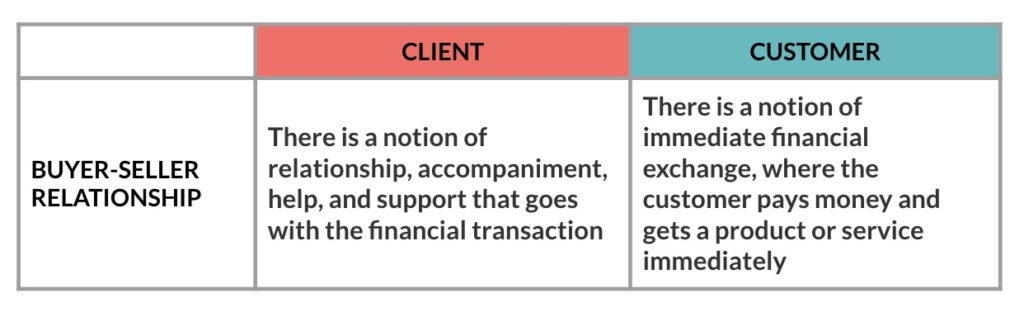
This does not mean that you can’t offer great customer service! You can have immediate transactions with your customers, and still give them personalized, friendly service.
Of course, it’s also possible to have good relationships with your customers (especially if they buy from you often!)
But the accompaniment & support for clients is in the context of the professional relationship, and the services the client pays for.
Also check out my lesson:How to Explain to a Client that Their Idea is Bad
3. Client or customer?: Difference in formality
Many of my clients often ask “Is it better to say ‘client’ instead of ‘customer’? No, there is NO difference in formality, sophistication, or register. It is not better to say “client” instead of “customer” just because you think it sounds more sophisticated.
The difference between “client” and “customer” depends on the thing they buy, and the relationship or support they receive, as we learned above.
Also check out my lesson:Make a Good Impression on Potential Clients
4. Client or customer?: What if I’m still not sure?
First, the good news is that no one will be offended if you confuse the two and call your customers “clients” or vice versa!
Second, let me give you some more examples, to help you feel more confident about which word to choose for your business:
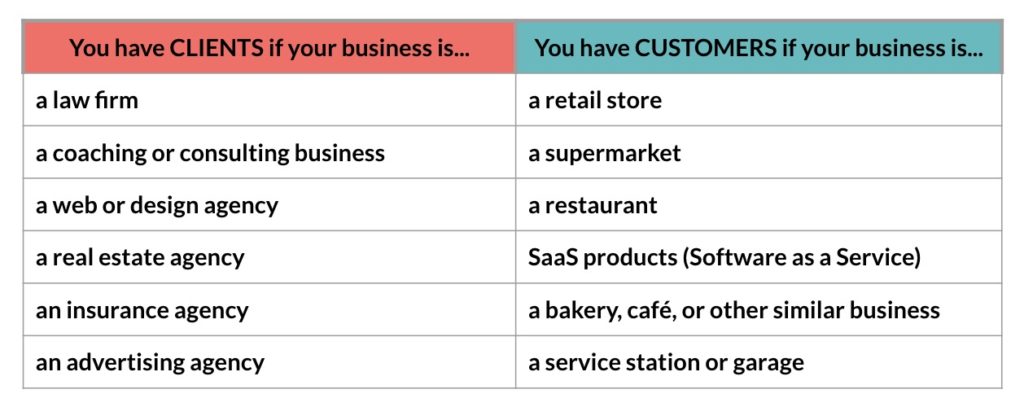
And now, you’re one step closer to feeling more confident speaking Business English!
Become more fluent & comfortable in conversations
If you would like to take the next step with me, discover my Faster Fluency Conversation Club Membership Program!
It helps you become more confident speaking in conversations, and get a lot more vocabulary on many different topics! And it’s a fabulous community of “English buddies” from around the world!
More details athttps://christinarebuffetcourses.com/faster-fluency-conversation-club/join-now
….
Have a good one,
Christina
More good stuff…
Click the image to learn more
Leave reply

Mario says:
Thank you, Christina. I would like to add another word: guest. As a hotel receptionist,
sometimes we address people as guests instead of clients or costumers.
Best regards,
Mario Seisdedos

Christina Rebuffet says:
Great remark, Mario! And you’re right, there are also other words that we can use to refer the people who do business with us: guests (in hotels, as you mentioned), users (of software), learners (people who buy products from a teacher), coachee (people who work with a coach), patron (another generic word for customer), etc. There are a lot of different words for the buyer-seller relationship in fact!

Rodrigo says:
Although these two words (client & customer) are similar in use and meaning, maybe if we go to check their etymology we can figure out a little bit more about their origin and if there is a difference between them.

Christina Rebuffet says:
Hi Rodrigo, Good idea! So I checked out the etymology, and here’s what I found: client – 1393, from Anglo-Fr. clyent, from L. cliens (acc. clientem) “follower, retainer,” perhaps a variation of cluere “listen, follow, obey” (see listen); The ground sense is of one who leans on another for protection.
custom – c.1200, “habitual practice,” from Latin *consuetumen, “habit or usage.” Sense of a “regular” toll or tax on goods is c.1325. Customer (14c.) meant “customs official” before meaning switched to “buyer” (first attested 1409).
So indeed, looking at the etymology does help us understand how the words evolved into their current meaning! Thanks for the tip!

Thiébaut Welterlen says:
Hi Christina, Thank you for this interesting video. For me there are two other words that are confusing : purchasing and procurement. For me, a purchaser is a buyer, someone who negotiate prices … but it seams that sometimes it is someone who place the order … An the opposite for a procurement manager !
Christina Rebuffet says:
Hi Thiébaut, Good question, and I remember when I was a teacher in a company, we had a debate about purchasing vs. procurement with other English teachers and our clients! Not an argument, but it was a lot of discussion to try to get the nuance between the two! I found this article, which gives a clear, visual explanation of the difference: https://kissflow.com/procurement/procurement-vs-purchasing/#:~:text=Purchasing%20focuses%20on%20short%2Dterm,itself%20with%20corporate%20strategy%20or
Hopefully, that can clarify it for you!

Business English lessons & tips

Improve faster and feel more confident with my free English lessons. Sign up today.
MOST RECENT EPISODES